
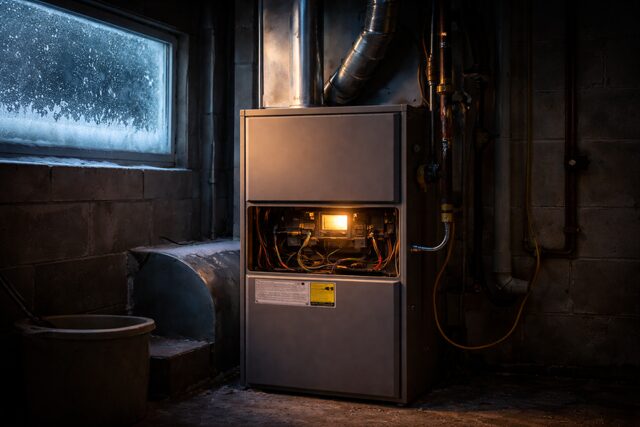
When temperatures plunge, the last thing you want is a failing heating system. Here are the most common winter HVAC problems — and what you can do about them before calling a pro.
1. Your Furnace Won’t Turn On
Nothing triggers a panic like a cold house and a furnace that simply refuses to start. This is one of the most common calls HVAC technicians get every winter — and surprisingly, it’s often something a homeowner can fix themselves.
The culprits are usually mundane: a tripped breaker, a thermostat set to “cool” instead of “heat,” a clogged air filter that’s caused the system to overheat and shut down, or a pilot light that’s gone out on older furnaces. Before assuming the worst, work through the basics.
Troubleshooting Steps
- Confirm the thermostat is set to HEAT and the target temperature is above the current room temperature.
- Check your electrical panel for a tripped breaker labeled “furnace” or “air handler” and reset it if needed.
- Inspect the air filter — if it’s grey and clogged, replace it immediately (this can trigger a safety shutoff).
- For older gas furnaces, check whether the pilot light is lit; relight per your manual if it isn’t.
- Make sure the furnace’s power switch (often on the unit or nearby wall) is in the ON position.
Pro Tip: If the furnace starts but shuts off again within minutes, a dirty flame sensor is often to blame — a quick clean with fine steel wool can fix it, but this is one to leave to a certified tech if you’re not comfortable with it.
2. Uneven Heating — Some Rooms Are Cold
Your living room is toasty, but the back bedroom feels like a walk-in freezer. Uneven heating is a widespread winter complaint, and it rarely means your entire HVAC system needs replacing. More often, it’s a ductwork, airflow, or insulation problem.
Blocked or closed registers, leaky ducts, or insufficient insulation in exterior walls can cause dramatic temperature differences between rooms. Zoning issues in larger homes can also create hot and cold spots, especially if your system wasn’t properly designed for your floor plan.
Troubleshooting Steps
- Walk through every room and ensure all supply and return vents are fully open and unobstructed by furniture.
- Check that doors to colder rooms aren’t blocking return air pathways — adequate return airflow is critical.
- Feel along accessible ductwork in your basement or attic for obvious gaps or disconnections and seal with mastic or foil tape.
- Add a portable space heater as a temporary fix while you investigate the root cause.
- Consider a professional duct balance or a ductless mini-split for a chronically cold room.
Pro Tip: Closing vents in unused rooms to “redirect” heat is a myth — it actually increases duct pressure and can damage your blower motor over time. Keep vents open throughout the home.
3. Strange Noises From the Heating System
A well-functioning HVAC system should be nearly silent. So when your furnace starts banging, squealing, rattling, or producing a persistent hum, it’s telling you something. Different sounds point to different problems — knowing the difference can save you from a more serious (and expensive) breakdown.
A loud bang or boom when the heat kicks on is often “delayed ignition” — a buildup of gas that ignites all at once, which is hard on your heat exchanger and needs immediate professional attention. Squealing usually points to a worn blower belt or bearing. Rattling often means a loose panel or debris in the system.
Troubleshooting Steps
- Banging/Booming on startup: This is a gas issue — turn off the furnace and call a technician promptly. Do not ignore this.
- Squealing or screeching: Indicates a worn blower motor belt or dry bearings. A tech can replace or lubricate these affordably.
- Rattling: Check and tighten all access panels on the unit. Look for leaves or debris near outdoor units.
- High-pitched whistling: Usually caused by restricted airflow — check the filter and look for partially closed vents.
- Clicking that won’t stop: May indicate a failing ignitor or relay — schedule a service call.
Pro Tip: Record the noise on your phone before calling a technician. The sound often changes or disappears by the time someone arrives, and audio helps your tech diagnose the issue faster and more accurately.
4. The Heat Pump Is Blowing Cold Air
Heat pumps are incredibly efficient — but they’re also commonly misunderstood. Many homeowners call for service in a panic because their heat pump seems to be “blowing cold air.” In many cases, the system is working exactly as designed. In others, something genuinely needs attention.
Heat pumps extract warmth from outdoor air, and the air they supply is often around 90–100°F — warm, but cooler than your body temperature, which can feel like cool air. However, if outdoor temps drop well below freezing and you’re relying solely on a heat pump without auxiliary heat, you may genuinely be under-heating your home. Additionally, a frozen outdoor coil or low refrigerant can significantly impact performance.
Troubleshooting Steps
- Place your hand in front of a vent — if air is around 90°F, the system is likely working normally; it just feels cool because it’s below body temp.
- Check if the outdoor unit is encased in ice beyond a light frost; a frozen coil signals a defrost cycle issue or refrigerant problem.
- Ensure the auxiliary or emergency heat strips are functioning (check your thermostat settings — there’s often an “AUX” or “EM HEAT” indicator).
- In extreme cold (below 30°F), manually switch to emergency heat as a temporary measure while scheduling service.
- Never pour hot water on a frozen outdoor unit — allow it to defrost naturally or call a tech.
Pro Tip: If you live in a region with frequent hard freezes, having your heat pump inspected and the defrost board tested before winter arrives is one of the best maintenance investments you can make.
5. Skyrocketing Energy Bills With Less Comfort
If your heating costs have spiked dramatically compared to past winters — and your home still doesn’t feel as warm as it should — your HVAC system is working too hard for too little result. This is a red flag that something in the system has degraded or that your home’s thermal envelope is failing.
Common causes include a failing heat exchanger, a dirty burner assembly reducing combustion efficiency, duct leaks losing conditioned air into unconditioned spaces, a failing blower motor running slower than it should, or simply poor insulation and air sealing throughout the home.
Troubleshooting Steps
- Replace or upgrade to a programmable or smart thermostat — setback scheduling alone can cut heating costs by 10–15%.
- Inspect weatherstripping on exterior doors and windows; seal any visible gaps with caulk or foam tape.
- Check insulation levels in the attic — this is the single highest-impact area for heat loss in most homes.
- Schedule an annual furnace tune-up: a clean burner and properly adjusted combustion can dramatically improve efficiency.
- Have a professional perform a duct leakage test if your ducts run through unconditioned spaces like an attic or crawlspace.
Pro Tip: If your furnace or heat pump is more than 15 years old and showing efficiency issues, run the numbers on a modern high-efficiency replacement (95+ AFUE furnace or 18+ SEER heat pump). The ROI is often 5–7 years, with significantly lower bills from day one.
Still Having Trouble?
When DIY troubleshooting hits its limit, the team at Absolute Comfort is ready to help — fast, honest service from certified technicians who know winter HVAC inside and out. Schedule a Service Call