
It’s the most overlooked HVAC task in the home — and skipping it costs you in higher bills, worse air quality, and shortened equipment life. Here’s the honest answer on timing, and why “every 90 days” is only part of the story.
The Quick Answer: Filter Replacement by Type
Filter thickness and material are the biggest factors in how long a filter lasts. Use this as your baseline, then adjust based on your household situation below.
| Filter Type | Thickness | Typical Lifespan | Frequency |
|---|---|---|---|
| Basic fiberglass | 1 inch | 30 days | Monthly |
| Pleated disposable | 1–2 inch | 30–90 days | Every 1–3 months |
| Mid-grade pleated | 2–4 inch | 3–6 months | Quarterly to biannual |
| High-efficiency media | 4–5 inch | 6–12 months | Every 6–12 months |
| HEPA (air purifiers) | Varies | 6–12 months | Every 6–12 months |
| Washable/reusable | Varies | Years (if cleaned) | Clean monthly |
Why Your Air Filter Matters More Than You Think
Your air filter is a quiet workhorse. It sits out of sight in a return duct or air handler slot and silently catches the dust, pet dander, pollen, mold spores, bacteria, and debris that circulate through your home every time the system runs. When it’s clean, air flows freely and your HVAC runs efficiently. When it’s clogged, everything downstream suffers.
A dirty filter forces your blower motor to work harder to pull air through the restriction — which drives up energy consumption, accelerates wear on mechanical components, and can trigger a safety shutoff in your furnace (the same one that makes homeowners call us in a panic on cold nights). Beyond the equipment, a clogged filter stops catching pollutants effectively, meaning those particles recirculate straight into your breathing air. And if the filter gets damp — which can happen when airflow is restricted and condensation builds — mold can grow directly on it and spread throughout the ductwork.
The good news: it’s one of the cheapest, easiest maintenance tasks in the whole home. A $10–$30 filter changed on the right schedule can prevent a $500 service call.
The 6 Factors That Actually Determine Your Schedule
The 90-day guideline is a useful starting point — but it assumes an average home in average conditions. Most households need to adjust based on at least one or two of the following factors.
Pets
Pet hair and dander dramatically accelerate filter clogging. One pet typically warrants checking every 60 days; multiple pets can mean a new filter every 30–45 days.
Adjust to: every 30–60 days
Home Size
Larger homes circulate more air volume through the same filter, meaning it fills up faster. A 3,000 sq ft home goes through filters noticeably quicker than an 800 sq ft condo.
Adjust to: more frequently
Allergies or Asthma
If anyone in your household has respiratory sensitivities, a fresher filter with a higher MERV rating makes a real, daily difference in air quality and symptom load.
Adjust to: every 30–45 days
System Usage
A system running year-round in extreme climates will clog a filter in half the time of one used only a few months a year. Heavy use in winter and summer accelerates the cycle.
Adjust to: more frequently in peak seasons
Nearby Construction
Renovation work inside the home — or a neighbor’s construction site — can send enormous amounts of fine dust and debris into your system. Check weekly during active projects.
Adjust to: check weekly
Occupancy
A single person working from home generates far less particulate than a family of five with kids and activity. More people means more dust, tracked-in dirt, and airborne particles.
Adjust to: every 30–60 days for busy households
Signs Your Filter Needs Changing Now — Regardless of Schedule
The calendar is a guideline. Your filter and your HVAC system will also tell you directly when it’s time. Don’t wait for the scheduled date if you notice any of these.
Replace immediately if you notice:
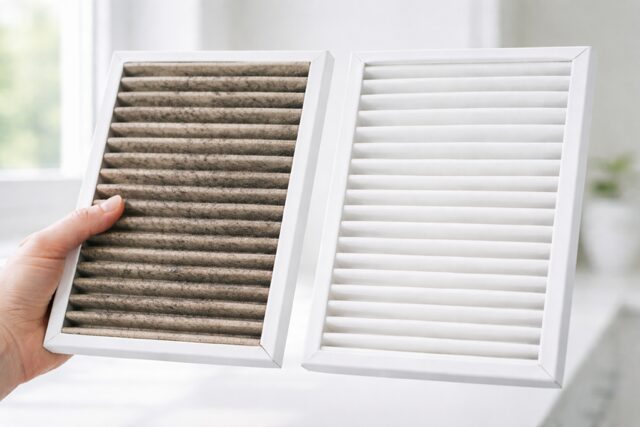
- The filter is visibly gray, dark, or completely caked with debris
- Holding it up to a light source, no light passes through
- Your home feels dustier than usual, especially on surfaces near vents
- Your energy bills have spiked without a change in usage habits
- The system is running longer cycles to reach the set temperature
- You notice a musty or stale smell when the HVAC runs
- Allergy or asthma symptoms in the household have noticeably worsened
- The filter looks physically damaged, bent, or has visible holes
- You can see or smell mold anywhere on the filter or near the vent
The Light Test: Pull the filter out and hold it up to a window or bright overhead light. If light passes through easily, it has life left. If it’s opaque — a solid wall of grey — it needed replacing days ago.
Does a Higher MERV Rating Mean Better?
MERV stands for Minimum Efficiency Reporting Value — a standardized scale from 1 to 20 that measures how effectively a filter captures particles of different sizes. Higher ratings trap smaller particles more effectively, but there’s a tradeoff most homeowners don’t realize: higher MERV filters are also denser, which restricts airflow more.
For most residential systems, MERV 8–11 is the sweet spot — effective enough to catch the particles that affect health and equipment, without creating enough static pressure to strain the blower motor. MERV 13 is increasingly popular for households with allergy sufferers and provides excellent filtration. Going above MERV 13 in a standard residential system can actually damage the equipment by starving it of airflow, so check your system’s manual or ask your HVAC tech before upgrading significantly.
Important: A higher-MERV filter may need to be replaced more often, not less — because it catches more particles faster and can clog sooner than a basic filter. Factor this into your replacement schedule when you upgrade.
How to Build a Filter-Change Habit That Actually Sticks
The reason most homeowners end up with a clogged filter isn’t laziness — it’s that air filter replacement is invisible until something goes wrong. Building a simple system makes it automatic.
The most reliable method is to tie filter checks to something you already do monthly — paying bills, checking smoke detector batteries, or the first of each month. A 60-second visual inspection every four weeks takes almost no effort, and after a few cycles you’ll have a precise feel for how quickly your specific filter loads up.
Subscription services that ship filters on a set schedule are a genuinely useful option for busy households — the arrival of a new filter in the mail is a reliable reminder. Buying filters in multipacks is more economical and ensures you always have a replacement on hand when you need one. Some smart thermostats now include filter replacement reminders based on system runtime hours, which is a more accurate trigger than the calendar alone.
Write it on the filter: When you install a new filter, take 10 seconds to write the installation date directly on the cardboard frame with a marker. The next time you open the panel, you’ll know exactly how long it’s been in there.
Not Sure What Filter Your System Needs?
The wrong filter size or MERV rating can hurt your system as much as skipping changes altogether. Our technicians can assess your setup and recommend the right filter for your equipment, home size, and lifestyle.