
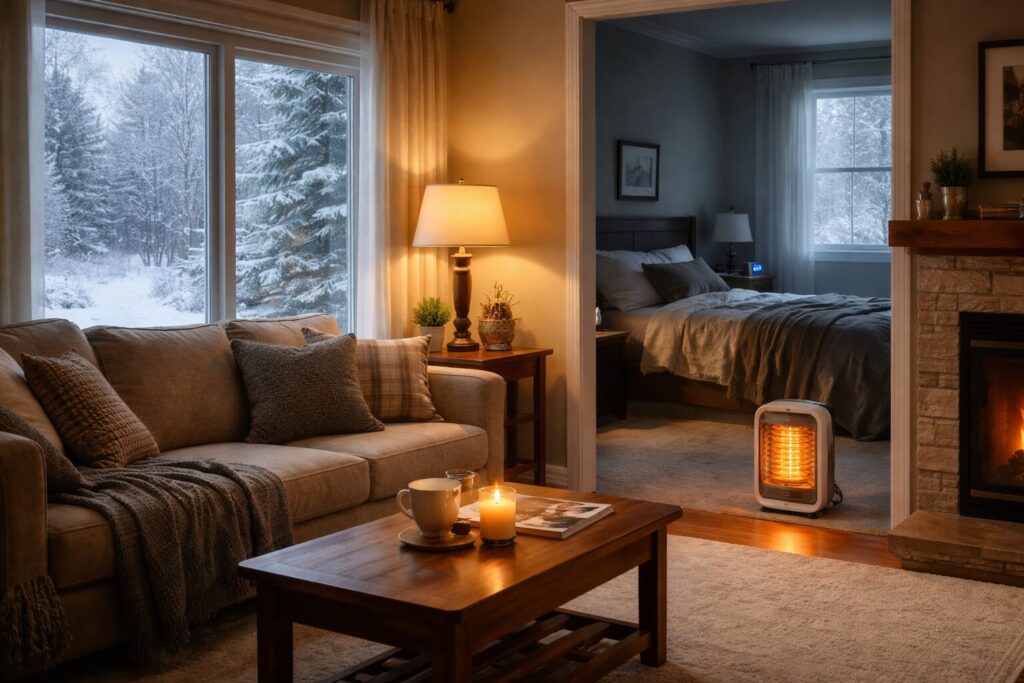
When a bedroom stays stubbornly cold or a basement never quite warms up, the solution can feel obvious: plug in a space heater. It’s quick, inexpensive upfront, and delivers immediate warmth.
But before you make a space heater part of your regular heating routine, it’s worth understanding the bigger picture. Space heaters affect your energy costs, safety, and HVAC system performance in ways many homeowners don’t realize.
At Absolute Comfort, we believe informed homeowners make better decisions about comfort and efficiency. Here’s what you should know before relying on a space heater this winter.
The Real Cost of Running a Space Heater
Most residential space heaters operate at 1,500 watts on their highest setting. That translates directly into electricity usage—and higher utility bills.
Here’s how the math breaks down:
- 1,500 watts = 1.5 kilowatt-hours per hour
- Average U.S. electricity rate: ~$0.16 per kWh
- Cost to run: ~$0.24 per hour
That hourly cost adds up quickly with regular use:
- 8 hours per day (typical home office use): ~$1.92/day
- One month: ~$60
- November–February (Indiana winter): ~$240 for a single heater
And that’s just one room.
By comparison, while a gas furnace uses more total energy, it heats your entire home—not just a small area. Natural gas remains significantly more cost-effective than electricity for heating, especially when paired with a modern, efficient HVAC system. On a cost-per-square-foot basis, space heaters are often more expensive than central heating.
How Space Heaters Interact With Your HVAC System
Space heaters don’t operate in a vacuum—they change how your HVAC system behaves.
Stacking Heating Costs
If you use a space heater without lowering your thermostat, both systems run at the same time:
- Your furnace continues cycling to maintain whole-home temperature
- Your space heater pulls additional electricity
Instead of replacing central heat, you’re paying for both.
Even When You Lower the Thermostat…
The savings are often negligible. Research from Cornell University found that:
- Lowering a home’s temperature by 10°F
- Supplementing with a space heater in one room
- Saved only $0.50–$0.80 per heating cycle
In many cases, that barely offsets the cost of running the space heater itself.
What Cold Rooms Are Really Telling You
Persistent cold spots usually signal an underlying HVAC issue, such as:
- Leaky or poorly sealed ductwork
- Inadequate insulation
- Improper system sizing
- Airflow or balance problems
A space heater masks the symptom—but the root cause remains. Over time, those unresolved issues can worsen and lead to higher energy bills and reduced system lifespan.
When Space Heaters Make Sense—and When They Don’t
Appropriate Uses for Space Heaters
Space heaters can be practical in short-term, targeted situations, such as:
- Working in a garage or workshop for a few hours
- Warming a bathroom before a morning shower
- Adding temporary heat to a sunroom on a cold afternoon
In these cases, the heater is supplemental, brief, and controlled.
When Space Heaters Become a Problem
Space heaters stop making sense when they become a daily necessity throughout the heating season. If you’re relying on one every day:
- You’re paying more than you realize
- You’re avoiding—not fixing—the real problem
- You’re increasing safety risks in your home
The Safety Risks Homeowners Can’t Ignore
According to the U.S. Consumer Product Safety Commission:
- Portable space heaters cause ~1,700 home fires annually
- Resulting in ~80 deaths and 160 injuries
- While they cause only one-third of heating fires, they account for 80% of heating-fire deaths
Critical safety rules include:
- Keep heaters at least 3 feet from anything combustible
- Never leave them unattended or running while sleeping
- Never plug them into extension cords or power strips
These risks make space heaters a poor choice for routine, long-term heating.
Permanent Solutions That Actually Work
If space heaters are compensating for persistent cold rooms, it’s time to fix the root issue. Permanent HVAC solutions deliver better comfort, efficiency, and safety.
Common Long-Term Options
Duct Sealing and Balancing
- Fixes leaks and airflow imbalances
- Ensures conditioned air reaches every room
- Often the most cost-effective solution when capacity is adequate
HVAC Zoning Systems
- Independent temperature control for different areas of the home
- Uses dampers and multiple thermostats
- Can reduce energy usage by up to 30% by avoiding unnecessary heating
Ductless Mini-Split Systems
- Ideal for additions, finished basements, or hard-to-heat rooms
- No ductwork required
- Provides efficient heating and cooling where you need it
System Upgrades
- Best when the furnace is old, undersized, or inefficient
- Modern systems distribute air more evenly
- Variable-speed blowers improve comfort and consistency throughout the home
How to Decide What’s Right for Your Home
Before buying another space heater, ask yourself:
- Am I using this heater daily throughout winter?
- Have I calculated the true monthly cost?
- Am I consistently following all safety guidelines?
- Would this money be better spent fixing the actual problem?
In our experience, Central Indiana homeowners who invest in permanent solutions enjoy:
- More consistent comfort
- Lower energy bills
- Improved safety
- Fewer long-term repairs
A Smarter Approach to Winter Comfort
Space heaters aren’t inherently bad—but they’re meant to be temporary tools, not substitutes for a properly functioning HVAC system.
The right heating solution keeps your home:
- Warm
- Efficient
- Safe
- Sustainable
Whether that means airflow improvements, zoning, ductless options, or a system upgrade, permanent solutions always outperform temporary fixes.
Ready to solve your home’s heating challenges for good?
Contact Absolute Comfort to schedule a comprehensive heating assessment. We proudly serve Carmel, Fishers, Noblesville, and surrounding Central Indiana communities with HVAC solutions built for lasting comfort—not quick fixes.