
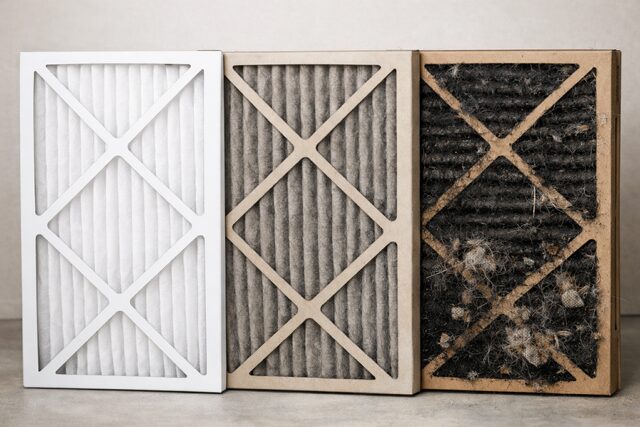
Most Central Indiana homeowners know they should check their HVAC filter regularly—but how many of us actually look closely at what we’re pulling out of that return vent? That gray, fuzzy rectangle might seem like just another household chore, but your dirty filter is actually communicating valuable information about your home’s air quality, your HVAC system’s health, and even problems you didn’t know existed.
Think of your air filter as a diagnostic tool. Just like a doctor can learn a lot from a simple blood test, the condition of your HVAC filter can reveal what’s happening inside your home and your heating and cooling system. Let’s decode what your filter is trying to tell you.
The Basics: What a Normal Dirty Filter Looks Like
First, it helps to understand what’s normal. A standard 1-inch pleated filter typically needs replacement every one to three months, depending on your household. When you pull it out at the end of its service life, you should see a relatively even coating of gray dust across the surface. This is your filter doing its job—trapping dust, pollen, pet dander, and other airborne particles before they can circulate through your home or damage your HVAC equipment.
The color matters too. A filter that’s gone from white to light gray is simply collecting normal household dust. But what about when your filter looks different?
When Your Filter Gets Dirty Too Fast
If you’re replacing your filter and it’s completely clogged after just a few weeks—or even worse, after a few days—your home is trying to tell you something. Here are the most common culprits:
Your Ductwork May Be Leaking
One of the biggest reasons filters clog prematurely is leaky return ducts. According to ENERGY STAR, the typical home loses 20-30% of its conditioned air through duct leaks. But here’s what many homeowners don’t realize: leaky return ducts don’t just waste energy—they actively pull unfiltered air from dirty spaces into your system.
Return ducts operate under negative pressure, creating suction. If those ducts run through your attic, crawl space, or basement and have gaps or disconnections, they’re pulling dust, insulation fibers, and debris directly to your filter. This contaminated air bypasses your living space entirely, which is why your filter might be filthy even when your home looks clean.
What to do: If your filters are clogging much faster than they should, have a professional HVAC technician inspect your ductwork. Sealing those leaks won’t just extend your filter life—it’ll also lower your energy bills and improve your indoor air quality.
You Have Furry Family Members
Pet owners in Fishers and Carmel know the struggle: no matter how much you vacuum, there’s always more pet hair. Dogs and cats shed constantly, and all that fur becomes airborne every time your HVAC system runs. The hair doesn’t just sit on your filter’s surface either—it creates a fuzzy mat that traps dust and debris, accelerating clogging.
What to do: If you have pets, plan to replace your filter monthly rather than quarterly. Regular grooming and weekly brushing can reduce the amount of loose hair before it becomes airborne. Daily vacuuming with a quality HEPA filter vacuum also helps capture settled hair before it gets recirculated.
Your Fan Setting Might Be Wrong
Check your thermostat. If your fan is set to “ON” instead of “AUTO,” your system is circulating air constantly—even when it’s not actively heating or cooling. This means your filter is catching particles 24/7, which can cause it to clog two to three times faster than normal.
What to do: Switch your fan setting to “AUTO” unless you have a specific reason to run it continuously. Your filter will last longer, and you’ll save on energy costs too.
Recent Home Projects Are Creating Extra Dust
Did you recently finish a bathroom remodel or have contractors in for repairs? Construction and renovation projects generate enormous amounts of airborne dust—from drywall dust to sawdust to tile debris. Even if you closed off the work area, that fine particulate matter can spread throughout your home and overwhelm your filter quickly.
What to do: During any construction project, close vents in the work area if possible and plan to change your filter more frequently. Consider upgrading to a higher-efficiency filter temporarily to capture more of those fine particles. Once the project is complete, give your ducts a thorough cleaning to remove settled construction dust.
What Black or Excessively Dark Filters Mean
If your filter isn’t just gray but actually black or has dark spots, that’s a more serious concern. Here’s what might be happening:
Mold Growth
Black discoloration can indicate mold, especially if the filter feels damp or has a musty odor. Mold thrives in moisture, and if there’s a leak in your ductwork or a drainage problem with your air conditioner, moisture can accumulate and create the perfect environment for mold spores to grow.
What to do: Replace the filter immediately and schedule an inspection with an HVAC professional. Mold in your HVAC system can spread spores throughout your home every time your system runs, potentially causing respiratory issues and other health problems.
Soot or Candle Residue
Burning candles frequently—especially scented candles—can leave a black, sooty residue on your filter. The same goes for using your fireplace. These particles are much darker than regular dust and can make your filter look worse than it actually is.
What to do: If you use candles or a fireplace regularly, expect to change your filter more often. Consider switching to soy-based candles which produce less soot, and make sure your fireplace damper is working properly.
When Filter Changes Don’t Solve the Problem
Here’s an important point: if you’re changing your filter regularly and still experiencing issues like poor airflow, uneven temperatures, or increased dust in your home, the problem might not be the filter at all.
Your HVAC System Might Be Incorrectly Sized
An oversized or undersized system can create airflow problems that stress your filter. A system that’s too large will short-cycle—turning on and off frequently without running long enough to properly filter air. A system that’s too small will run constantly, processing more air and clogging filters faster.
Your Filter Might Be the Wrong Type
Not all filters are created equal. A filter with a MERV rating that’s too high for your system can restrict airflow, making your HVAC work harder and reducing efficiency. Conversely, a filter with too low a rating won’t capture the particles your household needs filtered.
What to do: Consult with an HVAC professional about the right filter for your specific system and household needs. If you have pets or allergy sufferers, you might benefit from a whole-house air purification system that supplements your standard filter.
What Your Filter Reveals About Indoor Air Quality
The condition of your filter is a direct window into your indoor air quality. If your filter is collecting excessive dust, that dust was in your air before it was trapped. This means your family was breathing those particles before the filter caught them.
Common indoor air contaminants that show up on filters include:
- Dust mites and their waste
- Pet dander
- Pollen tracked in from outdoors
- Dead skin cells
- Mold spores
- Bacteria
- Smoke particles (if anyone in the home smokes or if you cook frequently)
According to the EPA, indoor air pollutant levels are often 2 to 5 times higher than outdoor levels—and in some cases can exceed 100 times outdoor pollution levels. A chronically dirty filter isn’t just protecting your HVAC system; it’s revealing that your indoor air needs attention.
The Cost of Ignoring What Your Filter Tells You
When homeowners ignore the messages their filters are sending, problems escalate:
Higher energy bills: A clogged filter restricts airflow, making your system work 15% harder according to the U.S. Department of Energy. That translates directly to higher utility costs every month.
Frozen evaporator coils: Restricted airflow can cause your air conditioner’s evaporator coil to drop below freezing, creating ice buildup that prevents cooling and can damage your compressor.
Premature system failure: When your HVAC has to work harder to push air through a clogged filter, it puts stress on the blower motor and other components. This can lead to breakdowns and significantly shorten your system’s lifespan.
Health issues: A saturated filter can’t trap new particles, so allergens, dust, and other irritants blow straight back into your home. Family members may experience increased allergy symptoms, respiratory issues, or asthma attacks.
Taking Action: What Central Indiana Homeowners Should Do
Your HVAC filter is one of the simplest and most affordable ways to protect both your home comfort system and your family’s health. Here’s how to make the most of this diagnostic tool:
1. Check your filter monthly. Even if your filter is rated to last 90 days, check it every month. Central Indiana’s varying seasons and weather extremes mean your system might run more than average during heat waves or cold snaps.
2. Keep a filter replacement schedule. Set a phone reminder or mark your calendar. If you participate in Absolute Comfort’s maintenance program, your technician will check and replace your filter during regular tune-ups.
3. Examine what you pull out. Don’t just toss that dirty filter—look at it. Is it evenly gray? Darker in spots? Fuzzy with pet hair? Damp? Each of these tells you something different about what’s happening in your home.
4. Upgrade when it makes sense. If you have pets, allergies, or chronic filter issues, consider upgrading to a higher-efficiency filter or adding a whole-house air purification system.
5. Address underlying issues. If your filters are consistently dirty too fast, don’t just keep changing them—investigate why. Schedule a professional inspection to check for duct leaks, airflow problems, or other system issues.
Your Home Is Talking—Are You Listening?
That humble air filter tucked away in your return vent is doing more than just keeping dust out of your furnace. It’s providing valuable feedback about your home’s air quality, your HVAC system’s health, and potential problems that could cost you money and comfort if left unaddressed.
The next time you change your filter, take a moment to really look at what you’re pulling out. What you see might just save you from a major repair down the road—or help you breathe easier in your home.